

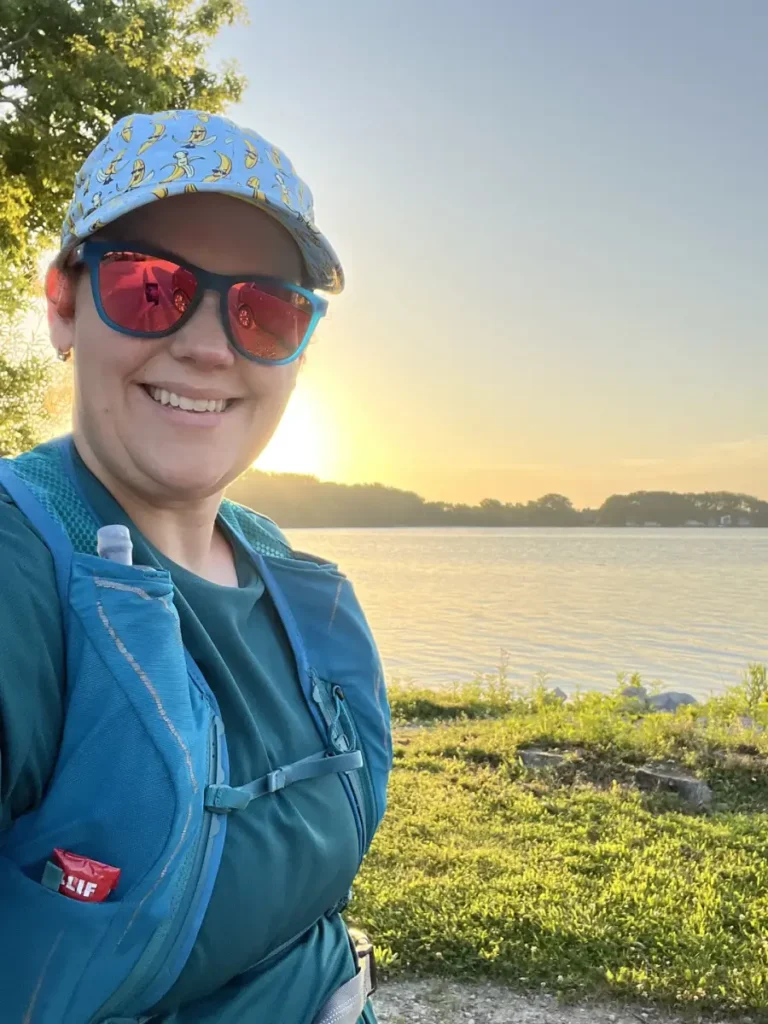
Latham Quality is proud to announce Rachel Dannewitz as the new manager of our seed conditioning and packaging facility in Alexander, Iowa. She becomes just the third person in our company’s 78-year history to hold this role — and the first female to do so.
Rachel’s first day made a memorable impression. Latham’s old soybean treater was being torn out and replaced with a brand-new one — part of an exciting investment in the future of our operations. This summer, we’re also tearing our scale house down to the studs and giving it a full remodel. There’s a lot of activity at the plant these days — and a lot of opportunity for Rachel to lead.
Rachel grew up in White Bear Lake, Minnesota — a suburb of the Twin Cities — and never expected to build a career in agriculture. “I was a theater kid,” she says. “I was involved in theater, debate and the speech team. I didn’t know much about farming and ag.”
That changed when she began studying plant biochemistry. Rachel earned her B.S. in Biochemistry from the University of Minnesota and went on to complete her M.S. in Biochemistry at Iowa State University, both with a focus on plants.
Rachel’s experience in agriculture and manufacturing includes leadership positions in soybean production. She most recently supervised 42 employees at Stitchcraft, a division of Winnebago, and spent nearly a decade at Bayer (formerly Monsanto), where she managed plant activities, implemented LEAN manufacturing principles, and led multiple seed technician teams. She’s also certified in ISO 9001 standards and has deep experience in continuous improvement, seed stewardship and plant compliance.
“I’m looking forward to getting back doing the things I enjoy,” Rachel says. “I love a new challenge — and being the Plant Manager means I can help Latham Quality grow into something awesome.”
Rachel and her husband, Jeremy, live in Clarion, Iowa, with their daughter, Vivian. Outside of work, Rachel is an avid runner, crafter and quilter. She and Jeremy even operate a longarm quilting business together, and she makes roughly 20 quilts each year to benefit Quilts of Valor.
Please join us in giving Rachel a warm welcome to the Latham Team! We’re excited for the future she’ll help shape — and grateful for the leadership she brings to our plant and our people.

Rachel’s favorite thing to make in the kitchen is bread, so she’s sharing her go-to No-Knead Bread recipe with us today.
No Knead Bread
- Large mixing bowl
- Wooden spoon or spatula
- Plastic wrap
- Parchment Paper
- Dutch oven
- 3 ½ cups all-purpose flour
- 2 teaspoons sea salt
- ½ teaspoon active dry yeast
- 1 ½ cups warm water
- Mix the dough. Stir together the flour, salt and yeast in a large mixing bowl until combined. Add in the warm water and stir with a wooden spoon or spatula until the dough is evenly mixed and no large flour streaks remain.
- Let the dough rise. Cover the bowl with plastic wrap or and let the dough rest at room temperature for 12 to 18 hours.
- Shape the dough. Transfer the dough to a well-floured surface. Fold the dough on top of itself — pulling the outer edges up and into the center a few times until the dough feels a bit tighter and holds its shape — to form a round dough ball. Lightly flour the top of the dough ball, and then carefully flip it upside-down onto a piece of parchment paper, so that the smooth side is on top. Use your hands to shape the ball into an even circle. Lightly flour the top of the dough ball, then loosely cover it with plastic wrap to rest while the oven heats.
- Heat the oven and Dutch oven. Place the Dutch oven inside of your oven, then set oven to 450°F. Wait for 20-30 minutes for the oven to heat, while the dough continues to rest.
- Bake. Very carefully, use oven mitts to remove the Dutch oven from the oven. Lift the edges of the parchment to carefully transfer the dough ball (along with the parchment) to the Dutch oven. Cover with the Dutch oven lid and bake for 30 minutes. Then carefully remove the lid and bake for 10-20 more minutes, until the crust of the bread reaches your desired level of doneness (as light or as deeply golden brown and crispy as you prefer).
- Serve. Remove from the oven, uncover and then carefully lift the edges of the parchment to transfer the bread to a wire cooling rack. Cool for at least 30 minutes, then slice.