“Rootworm Damage to Bt Corn” has been making the headlines ever since word got out about research findings, documenting corn rootworm injury to Bt corn. Iowa State University (ISU) researchers published findings on July 29; the University of Illinois issued a press release Sept. 23.
Researchers say “growers should be careful not to jump to the conclusion that fields with severe rootworm injury are supporting a resistant western corn rootworm population.” In fact, university research data confirms that the real strategy for dealing with high corn rootworm pressure is to use rootworm-traited genetics in addition to other strategies. Additional management strategies against rootworm may include the return to the use of insecticides, crop rotation, changing which Bt trait is used from year to year and the use of hybrids that contain multiple traits for rootworm resistance (i.e. SmartStax).
These research findings suggest that improvements in resistance management and a more integrated approach to the use of Bt crops is necessary. Discovering resistance in a limited geography is a great reminder to “respect the refuge” and preserve the widespread use of the Cry3Bb1 protein. The Cry3Bb1 protein is found in many top-selling corn hybrids throughout the industry and remains an important component of a farmer’s corn rootworm strategy
When asked to join the 2011 Iowa /Uganda Farmer-to-Farmer Exchange, I jumped at the opportunity. I’ve been raising row crops and beef cattle in Franklin County since I graduated from Iowa State, and so I understand first-hand some of the challenges women face as farm operators.
I was eager to learn about the challenges facing Ugandan farmers in general – and women farmers in particular – and this trip has been quite eye-opening to say the least. There are so many differences between our two countries and our two cultures. For starters, the entire country of Uganda is slightly larger than the state of Iowa. But Uganda has a population of 34 million people as compared to Iowa with just 3 million! When we tell the Ugandans there are more hogs than people in Iowa, they laugh.
The average farm size is 4 acres in Uganda, but we met one very successful woman who has 250 acres. This is a lot of work considering it is all done by hand. I have yet to see one tractor or even an ox plow.
This lack of equipment creates some challenges for farmers to get their product to market. For example, Tuesday we visited the Kamuli Mill. Farmers bring their white corn here where it is either sold directly to the mill or ground.
There are also middlemen involved because many farmers don’t have a way to transport grain to the mill. In order to afford hired transportation, a farmer must have large enough quantities of grain. A farmer could receive better prices if the grain gets transported to a larger market. That’s why I’m working on a project to help farmers market collectively for better prices.
It’s hard to believe that I only have four more days here! The farmers we have met in Uganda have been so appreciative of our help. They’re especially appreciative of everyone who is making this exchange possible. The 2011 Iowa /Uganda Farmer-to-Farmer Exchange and development project is coordinated by the Iowa State University Extension and Outreach Global Program, in collaboration with the Center for Sustainable Rural Livelihoods (CSRL) in the College of Agriculture and Life Sciences at ISU, and VEDCO, a non-profit organization based in Uganda. The project is funded by the United State Agency for International Development (USAID) through Weidemann Associates.
With football (and thus tailgate) season right around the corner, it’s time to start thinking about ice cold beverages and game day fare. It’s also time to pull the tailgate coolers out of hibernation. Most fall football days, heading to the game party means packing the cooler to the brim with snacks and drinks, dumping in some ice and heaving the heavy thing into the trunk. Then you hope your final tailgate destination doesn’t require a long walk with cooler in tow!
That’s the old way to tailgate. One lucky participant in Latham’s Third Annual Freedom of Independence Ride will get to experience the new way to tailgate this football season. One lucky rider will win the Cruzin Cooler, valued at $500. This cooler doesn’t require heavy lifting. You simply pack it up, hop on, and ride! Designed to help individuals keep beverages cool without the hassle involved with a regular cooler, the Cruzin Cooler holds a case of your favorite frosty beverages. Plus, it can travel at speeds up to 17 miles per hour!
Check out the cooler in action by viewing the video below.
“Labor of Love” Leads to Tours of Historic Tyden No. 6 Farm
NORTH CENTRAL IOWA FARM COUPLE ROLLS OUT THE WELCOME MAT, AUG. 26-28
“Visit the past with a touch of the present,” is the inviting headline on a brochure about Tyden No. 6 Farm Tours. Ted and Judy Pitzenberger of Dougherty, Iowa, are opening their 10-acre homestead to guests on Aug. 27-28. There is a limit of 40 people per tour, so call 641-794-3341 today to reserve your spot!
“We’ve really enjoyed restoring this place, but it wouldn’t be nearly as fun if we couldn’t share its history and the story of Emil Tyden with others,” says Ted, as he and Judy walk with me inside the stately barn.
Col. Emil Tyden
Col. Emil Tyden, a Swedish immigrant, came to this country in the 20th century with only $20 to his name and went on to become a successful inventor and entrepreneur. He held 200 patents, and one of those was for a metal seal that is still being used by railroad and trucking companies today to secure freight. With profits from his manufacturing businesses, Tyden built eight farms in Floyd and Butler Counties.
Tyden’s farms were extremely unusual at the time as he built them during the Great Depression and he built them with grandeur. But, he also built them to be functional and profitable. The video link below includes an interesting 5-minute documentary on Col. Tyden and his North Central Iowa farms. (NOTE: WHO Radio listeners may recognize the narrator’s voice of beloved farm broadcaster Lee Kline, who is Judy’s second cousin.)
The Pitzenberger family has been connected to the landmark Tyden farms for years.
“We started our married life at Tyden No. 3 in the hired hand’s house because Ted’s dad lived in the main house,” says Judy. “Then we had a chance to buy Tyden No. 6 and moved here in 1994.”
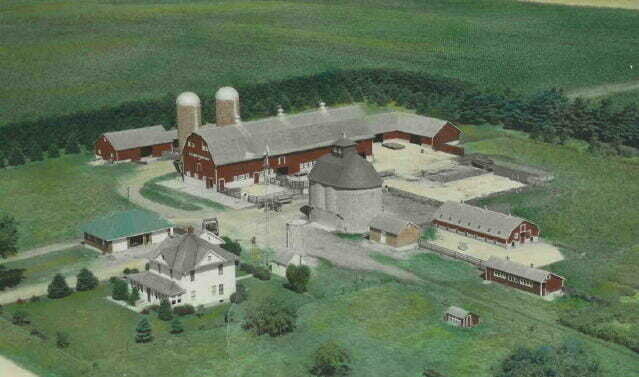
Tyden No. 6 has been a “labor of love” for the past 17 years and it shows. The Pitzenberger farm has been named “one of the prettiest farms” by Our Iowa magazine. They have taken great care to restore the massive red barn, which measures 40 x140 feet and could hold 20,000 bales of hay. Another of the farm’s distinguishing features is a 60-feet tall corn crib made from concrete block. There is also a summer kitchen stocked with pans, utensils and bottled soap from Judy’s family. And as a young boy, Ted ate cookies straight from this oven that is the cornerstone of the summer kitchen.
The Pitzenbergers have so many interesting stories to tell. Ted also makes sure he gets the story behind each piece of vintage farm equipment he buys. Most recently, he purchased a horse- drawn sickle mower that he literally had to cut out of a tree. He learned it was used in 1920s.
Even their flower beds tell stories! Family heirlooms in the flower gardens add charm and whimsy. A rock garden displays their family tree by including stepping stones with footprints of Ted and Judy’s parents in some and footprints from some of their 13 grandchildren in others. (Grandchild number 14 will arrive in September.)
With an appreciation for history and a love of agriculture, it’s only fitting that the Pitzenbergers are the owners and caretakers of a farm listed on the National Register of Historic Places. It’s also fitting that they’re carrying on the legacy that Col. Emil Tyden left of “implementing science into farming practices” with the way they raise crops today. They farm beside two of their sons, Phil and Ian, in Floyd and Butler Counties. Their oldest son, Troy, lives in New Hampton with his family. Their youngest daughter, Jenay, lives in Cedar Rapids with her family.
When this family gets together, there’s sure to be good times and good food like Judy’s versatile Amish Butter Cookies. I’m looking forward to mixing up a batch soon!
Nothing compares to the Iowa State Fair, Aug. 11-21! Where else could you watch celebrities build awe-inspiring exhibits with Canstruction®, one of the world’s most unique food charities? Or eat a multi-course meal on a stick including cheese cube appetizers, fruit kabobs, pork chop entrées and fried Twinkies for dessert? Where else could you visit Crystal Studios and see the live production of a top-rated farm broadcast?
Be sure to tune into “The Big Show” on Monday, August 16, between 11:30 a.m. and 1:00 p.m. as I’ll be a guest of Mark Pearson and Bob Quinn.
Next week I’ll experience all of this and more! One of my first stops on the fairgrounds will be at 1040 WHO Radio’s Crystal Studios. Be sure to tune into “The Big Show” on Monday, August 16, between 11:30 a.m. and 1:00 p.m. as I’ll be a guest of Mark Pearson and Bob Quinn. I never know exactly what we’ll be discussing on-air, but I’ll be sure to provide an update on Latham Hi‑Tech Seeds’ / WHO Radio Crop Tour 2011stops.
My next stop on the fairgrounds will be in the Agriculture Building. This year marks the 100th anniversary of the butter cow, so I can’t wait to see what’s in store for this milestone celebration. “While other state fairs may mimic the butter cow or tout other creamy creations, none has gained as much fame as the original,” said Iowa State Fair President Gary Slater in an AP article on Aug. 10. “None of the others have become that one thing that when you think of the fair like you do here at the Iowa State Fair. It’s become our icon.”
I’ll go from the iconic butter cow exhibit to a brand new exhibit by Iowa Food & Family featuring Canstruction. Located in the south entrance of the Varied Industries Building, this exhibit will feature a larger-than-life replica of the butter cow made from canned food items. Throughout the week, celebrities like Iowa Secretary of Bill Northey and ISU’s beloved mascot, Cy, will be help build works of art from canned foods. After the fair, all canned food items will be donated to the Iowa Food Bank Association. You can even participate by bringing your own non-perishable food items to this special exhibit.
Yes, indeed, nothing compares to the Iowa State Fair! As a tribute the fair – and in honor of National Peach Month – today I’m sharing with you one of my daughter’s favorite breakfast foods. She loves the wholesome goodness of these Honey Peach Muffins. And what goes better with muffins than Real® butter? Try your hand at making these pretty, yet simple, star-shaped pats of butter or whip up some home-made butter in a jar.
What is your favorite thing to do, see or eat at the state fair?
Together We Can, A Celebration of Food and Farming
Aaron Putze
Director of External Relations &
Coordinator, Iowa Food & Family Project
Iowa Soybean Association aputze@iasoybeans.com
There are few celebrations more enjoyable and meaningful than the Iowa State Fair! After all, it’s not just every day that you can enjoy a pork chop on a stick, fried Twinkies and a full menu of entertainment – both new and old – that’s perfect for people of all ages.
Speaking of new, the Iowa Food & Family Project (www.iowafoodandfamily.com) will make its debut in a big way at this year’s Fair by bringing together thousands of canned food items and a committed team of volunteers. Together, they’ll create a first-of-its-kind exhibit at one of the most popular celebrations of food, fun and agriculture in America!
We’re calling it “Together We CAN!” – a celebration of food and farming benefiting the Iowa Food Bank Association, and you’re invited to be a part of the festivities!
The exhibit will feature the awe-inspiring work of Canstruction®, one of the world’s most unique food charities. Canstruction is a non-profit organization that holds annual design-and-build competitions to construct giant-sized structures made entirely of canned food. Since 1992, Canstruction has contributed more than 15 million pounds of food to community food banks.
Located in the south atrium of the Varied Industries Building 9 a.m. – 9 p.m. daily, this must-see exhibit will include larger-than-life replicas of the Iowa State Fair butter cow (in honor of its 100th anniversary), a milk carton, market-size hog and landscape of soybeans and corn fields — all sculpted from thousands of cans of food (the actual build will take place Aug. 11-14). Following the fair, all food items used in the exhibit will be donated to the Iowa Food Bank Association (IFBA) benefiting Iowans struggling against hunger.
The purpose of the exhibit is to encourage conversations about farming, inspire greater awareness of the commitment of Iowa farmers to providing healthy food for everyone and provide a helping hand to people and families struggling with hunger.
You’re cordially invited to stop by and view this extremely innovative and unique exhibit. In addition to seeing an incredible work of art and donating to the Iowa Food Bank Association, you can also receive a free gift and watch “Celebrity Builders” lend a hand during the exhibits “Canstruction!” They include “Cy,” Iowa Ag Secretary Bill Northey, Des Moines native Rebecca Meyer (the Season 8 at-home $100,000 winner of NBC’s “The Biggest Loser”) and members of Casting Crowns, a Grammy Award-winning contemporary Christian rock band (see our web site for a complete list of Celebrity Builders!).
We’re looking forward to engaging fairgoers about the miracle of food and introducing them to the people who provide it! In the meantime, be sure to “friend” the Iowa Food & Family Project at www.facebook.com/foodnfamilies and check out our web site for more details!
Glyphosate has been called the world’s greatest herbicide because its overwhelming use and acceptance has made it the most widely used product on the market today. Dr. Stephen Powles, world-renowned expert on weed resistance, takes it one step further by saying that glyphosate is to weed control in agriculture as penicillin is to disease and infection treatment in medicine. Both are considered miracle products and given the distinction of being a “once-in-a-100 year discovery.”
So what can be done to help preserve the use of this wonderful chemistry? According to many weed scientists in the Upper Midwest, there are some basic steps that every farmer should take to prevent the onslaught of glyphosate-resistant weeds:
Know your weeds and know your fields. Closely monitor problem areas with tough-to-control weeds or what may be considered escapes or misses.
Start with clean fields. Use tillage, residual herbicides and/or burndown applications of herbicides to control all emerged weeds before planting.
Apply herbicides correctly. Proper application methods and rates are crucial to season-long control. The three most important factors are timing, timing and timing!
Control weed escapes. Because of the long-term ramifications of this problem, farmers can no longer be satisfied with “economic thresholds” of weed control.
Reduce the seed bank. Surviving weeds must not be allowed to set seed and thereby become the dominant weed species.
Clean equipment. Prevent the spread of these resistant weeds at all cost.
No single tactic will protect the potential crop yield nor deter the evolution of herbicide-resistant weed populations, said ISU Extension Crop Weed Specialist Mike Owen, in a blog article he posted earlier this season. Be proactive and manage herbicide resistance before it becomes a major problem. Diversity of tactics is the key to consistent weed management and high crop yields.
Franklin County 4-H to Hold Pancake Breakfast July 17
WHO: Everyone!
WHAT: Pancake breakfast
WHEN: Sunday, July 17, 2011, from 7:30 to 10:30 a.m.
WHERE: 4-H Food Stand on the Franklin County Fairgrounds
Help support the Franklin County 4-H Scholarship Endowment! All are invited to enjoy food and fellowship during a pancake breakfast presented by Franklin County 4-H.
Free will donations will be accepted to support the youth scholarship endowment fund.
We at Latham Hi‑Tech Seeds wish all of you a Happy and safe 4th of July holiday. We’re proud to be Americans, and thank all soldiers and veterans for fighting for the freedoms we get to enjoy everyday. God Bless the USA!
One reason I’m still celebrating “June Dairy Month” on the first of July is because I want to savor as much of summer as I can. (It seems like the summer passes too quickly once we’ve celebrated the Fourth of July.) Another reason that I’m featuring dairy recipes today is because they will make it easy to entertain guests over the holiday weekend.
Whether you’re planning to celebrate this weekend with a group of 4 or 40, TheFieldPosition.com has the perfect dessert for you! This quick, easy Chocolate Mousse recipe is a cool treat on a hot summer’s day for a Party of 4. The Buster Bar Dessert easily feeds 12 people, while Brownies in a Roaster serves 40.
May you and your family enjoy a safe and fun holiday weekend as you celebrate our nation’s independence and pay tribute to those who have fought for our freedom! From patriotic printables to celebratory centerpieces and hand-made parade wear, FamilyFun offers dozens of craft and game ideas for kids of all ages.
If the weather cooperates, our family will spend as much of the weekend outdoors as possible. We’ll golf, swim, bike and, of course, watch the fireworks.
What’s your favorite way to celebrate the Fourth of July?
Buster Bar Dessert
Ingredients:
1 package of Oreo® cookies
2 c. powered sugar
1 can evaporated milk
1½ sticks margarine or butter
¾ c. chocolate chips
1½ cups Spanish peanuts
½ gallon of vanilla ice cream, softened
Directions:
Crush Oreos and then stir in melted margarine. Pat mixture into 9×13 pan. Set aside.
Mix together powdered sugar, evaporated milk, 1 stick margarine and chocolate chips.
Then boil these four ingredients for 8 minutes, stirring constantly. Let the mixture cool completely.
Meanwhile, sprinkle ¾ c. Spanish peanuts over the Oreo crust. Then slice ice cream over the nuts. Sprinkle ¾ c. Spanish peanuts over the ice cream. Then pour the cooled chocolate sauce on top and place in the freezer.
COOK’S TIP: This dessert is also festive during the holidays. Use the holiday Oreo cookies with peppermint ice cream.