Skip to content
Latham Hi-Tech Seeds

(641) 692-3258

  • Home
  • Performance
  • Products
    • Corn
    • Soybeans
    • Alfalfa
    • Corn Silage
    • Seed Guide
  • Find a Rep
  • Media
    • Blog
    • News
    • Videos
    • Podcasts
    • TECHTalk
  • About Us
    • Company History
    • Our Mission
    • Careers
    • Become a Rep
    • Sowing Seeds of Hope
  • Contact Us
  • Latham Hi‑Tech Seeds

    Latham Customers “Hang Loose” in Hawaii

    While it sounds so cliché, time sure does fly when you’re having fun! It’s hard to believe that already one week has passed since we boarded a plane for Maui, Hawaii.  Thursday, Feb. 9, was a travel day.  Upon arrival in Lahaina, we dipped our toes in the Pacific Ocean and walked along the volcanic sand beach.  Then we enjoyed an oceanview dinner while watching whales flip and spout near the shoreline.

    The next morning we boarded a charter bus tour for a tour of Monsanto’s production and research facility in Kihei.  It was interesting to learn about the key role Hawaii’s seed crops play in the development of new corn hybrids.  Because farm fields in Maui can produce up to four crops each calendar year, a new hybrid can be developed in about half the time it would take if a seed company relied solely on growing conditions found on the continental U.S.

    Saturday was a “free day,” so many group members enjoyed an all-day trip along the Road to Hana while others chose to go whale watching or snorkeling.  Some even rented Harley’s and biked around the island.  My family and I chose to board an Atlantis submarine that took us below the ocean to a depth of 127 feet where we viewed white-tipped reef sharks, Hawaiian green sea turtles and hundreds of tropical fish.  (NOTE: I really enjoyed this submarine tour. It provided the same views as scuba diving without the pain of not being able to clear my ears.)

    Sunday morning we met in the hotel lobby at 2:15 a.m. (6:15 a.m. CST) to take a long, winding, 38-mile bus ride to Haleakala National Park.  The road we traveled is one of the world’s steepest, going from near sea level to the 10,023 summit.  We finally arrived inside the park where we viewed an amazing sunrise.  No wonder Haleakala means “house of the sun” in Hawaiian.  It truly looked as though you could step off the crater and onto a cloud.

    Forty members of our group enjoyed biking (more like “braking”) down from the base of Haleakala National Park to headquarters of the Haleakalah Bike Company.  “The original Freestyle Haleakala Downhill” included a 3,000-foot drop in 10 miles, curving around 29 switch backs.  It was after noon when many bikers returned to the hotel, where they enjoyed the afternoon and evening on their own.

    Monday was another “free day.”  My family chose to snorkel Molokini Crater.  It was fab-u-lous!  This tour truly lived up to its ad:  Snorkel a beautiful reef teeming with colorful marine life and experience one of the best whale watch’s on Maui. Enjoy a freshly prepared BBQ lunch served hot off the grill.  After lunch, we cruised to Turtle Town where our son had the experience of a lifetime.  He came face-to-face with two Hawaiian Green Sea Turtles and snapped, what we hope will be, a blue-ribbon winning photo at this summer’s Franklin County Fair.  As we headed toward shore, we saw many Humpback whales and had the pleasure of watching a calf breach.

    Monday evening our entire group enjoyed a luau including a Hawaii-style pig roast, where a large pit was dug into the ground and lined with banana leaves.  Hot lava rocks were placed into the pit, and then a seasoned pig was placed inside and covered with additional banana leaves.  The food was good, but I believe the cultural dances were even better.  The fire dancing finale was captivating (and in my humble opinion) any video can’t do it justice.

    After spending five nights and six days in a tropical paradise – plus enduring 16 straight hours of travel – yesterday afternoon we returned home.  Now it’s back to reality… and back to work!  I’m working on a blog for tomorrow that will feature a couple of tasty Hawaiian recipes, including one from Maui Gold Pineapple.

    Team Latham

    February 16, 2012
    Agriculture, General, Industry News
  • Latham Hi‑Tech Seeds

    Hawaii’s Seed Crops Experience Exponential Growth

    Last Friday guests of Latham Hi‑Tech Seeds had the opportunity to visit Monsanto’s research and production operations based in Kihei, Maui.

    Move over sugar cane, pineapples and tropical flowers…  seed crops are now the highest value commodity in Hawaiian agriculture.  The value of Hawaii’s seed industry set a new record high of $247.2 million for the 2010-2011 season.

    Since its roots were established 40 years, Hawaii’s seed crop industry has experienced exponential growth.  Hawaii’s seed crop industry has grown an average of 14% in value since 1968.  The seed industry serves as one of state’s few stable sectors for jobs, according to a study commissioned by the Hawaii Farm Bureau Federation.  The seed crop industry provides 22.7% of all agricultural jobs in the state.

    Hawaii’s seed crop industry also contributes substantially to the state’s public policy objectives:

    • Economic diversification
    • Maintaining prime lands for ag use with any incentive to convert these lands to alternative use
    • Creating Hi‑Tech jobs

    The rapid adoption of Hi‑Tech crops has also fueled growth of Hawaii’s seed crop industry.  Its climate allows research operations to play a critical role in the development of new corn hybrids.  Farms fields on Maui can produce up to four crops in just one calendar year!  That means a new hybrid can be developed in about half the time it would take if a seed company relied solely on more temperate growing conditions found on the continental U.S.

    Last Friday Paul Koehler and David Stoltzfus who work for Monsanto in Kihei, Maui, explained to a group from Latham Hi‑Tech Seeds the key role Hawaii plays in hybrid development:

    1st generation (parent seed increase) in Hawaii
    0.3 acres of parent line increase planted in Hawaii, harvested and planted again

    Second generation (parent seed increase) grown in Hawaii
    35 acres of parent seed increase, harvested and sent to South America

    Hybrid seed production grown in South America
    3,500 acres of hybrid seed production planted in South America, harvested and sent to North America

    Hybrid seed sent to North America
    600,000 acres of hybrid seed planted in North America as a full-scale commercial release

    Developing new hybrids that help farmers produce more crops while conserving more natural resources is going to be critical to meet growing global demands.  The world’s population is expected to grow by 40% in the next few decades.  That means farmers will need to grow as much food in the next 50 years as they did in the past 10,000 years combined!

    And that’s why seed companies like Latham and Monsanto are on a mission to help farmers produce higher yields.  It’s also why Monsanto invests more than $3 million a day on R&D. As a result of these investments, Genuity® products are providing increased yields, reducing chemicals into our water supply and helping to feed a growing population

    Team Latham

    February 15, 2012
    Agriculture, General, Industry News, Seed Technology
  • Latham Hi‑Tech Seeds

    Farm Bill Debates Goes Beyond Farming

    MUSINGS OF A MIDWEST PIG FARMER
    by Larry Sailer

    Photo courtesy of AgriNews.com

    A few days ago, I heard Judy Woodruff interview U.S. Secretary of Agriculture Tom Vilsack about America’s Agricultural Success.  She says, “Amid all the worry about how long it will take the economic recovery to kick into high gear, there’s a little-noticed sector that’s doing very well, thank you: American agriculture.”

    Sec. Vilsack credits agriculture’s success to “an extraordinary investment in infrastructure…  Farmers are buying lots of new machinery, like large tractors with sophisticated GPS systems, leading to new hiring on the part of companies like John Deere, which recently added 250 people at a plant in Ankeny, Iowa, that manufactures cotton pickers.”

    Auto-steer tractors are just one example of how agriculture is fueling the economy.  Biotechnology is also important an important economic contributor.  Technology has redefined agriculture in other ways, as well.  Agriculture technology, ranging from the Internet and SmartPhones to Genuity® SmartStax® RIB Complete CornTM and Genuity Roundup Ready®2 Yield Soybeans, has led to greater business efficiencies and even increased yields.

    With this in mind, it’s easy to understand why Woodruff would say there are many more facets to agriculture’s success story.  I find it disconcerting, however, that she specifically mentions “two particular bright spots” in the ag sector as the federal department’s housing and food assistance programs.  Neither of these so-called “bright spots” are directly related to farming, yet they make up the lion’s share of the USDA’s budget.

    Woodruff’s interview with Sec. Vilsack opened my eyes that the Farm Bill debate is not just about farming.  The Farm Bill is a very complex program that has a huge budget and will need to involve a lot of hearings and a lot of give and take to build into the new program.


    Larry Sailer, Musings of a Pig Farmer

    February 14, 2012
    Agriculture, General, Industry News
  • Latham Hi‑Tech Seeds

    Breakfast Bowl 2012: Latham Wants to be the “Fan Favorite”

    Every second counts!  And that’s why Latham Hi‑Tech Seeds hopes to take 10 seconds off the clock by receiving the most number of votes in a Facebook poll being sponsored by Franklin County Farm Bureau.  Please vote – and encourage your friends & family to vote – between Feb. 13-24.

    This poll is just one of the ways Franklin County Farm Bureau is celebrating Food Check-Out Week, Feb. 19-25.  This year’s theme is “Stretching Your Grocery Dollar With Healthy, Nutritious Food.”

    To help illustrate this theme, Franklin County Farm Bureau is hosting a “Breakfast Battle ” on Feb. 24 beginning at 8 AM at Fareway in Hampton. Three-person teams, including one from Latham Hi‑Tech Seeds that is being captained by yours truly, will battle it out to see which one can purchase enough items for breakfast, lunch and dinner for a cost of $45-50 dollars in the quickest amount of time.

    The Breakfast Battle is being planned as a fun event for participants to have fun, while getting people together all in an effort to make a difference for those who are less fortunate.  Franklin County Farm Bureau will pay for all of the groceries purchased during this competition.  The grocery items will then be delivered to needy families throughout the county with the help of the Franklin County Food Pantry in Hampton and the Immanuel UCC Food Pantry in Latimer.

    “Today, we have so many choices when we purchase food at the grocery store,” says Jim Dannen, Franklin County Farm Bureau President. “We, as farmers, want to show people not only on where their food comes from, but help consumers choose foods that are healthy and wholesome. Eating healthy on a budget takes planning.”

    Let the planning begin!  I’d appreciate any tips you can provide to help me plan three meals within the $45 to $50 budget.  Feel free to send me your ideas at shannonl@lathamseeds.com.  Also feel free to share some recipes with me to assist with my grocery shopping list!  

    Team Latham

    February 13, 2012
    Agriculture, General, Industry News
  • Latham Hi‑Tech Seeds

    Support Science, Not Sensationalism

    One year ago the U.S. Department of Agriculture’s decision to approve Roundup Ready® Alfalfa renewed a debate about the safety of genetically modified crops and the use of glyphosate in the environment.  During this same time period, retired Purdue University professor Don Huber proclaimed the discovery of a plant pathogen “… that appears to significantly impact the health of plants, animals and probably human beings.”

    With his “15 minutes of fame” expiring, Huber appears to be fanning the flames of his theory in hopes this issue will reemerge like a phoenix from the ashes.  Recently I heard him being interviewed on the radio program, “Coast to Coast,” and was amazed by the sensational, unscientific claims he was making.

    Huber’s claims were not – nor have they ever been – substantiated.  That’s why it concerns me greatly that many well meaning Americans will hear Huber speak and be scared into thinking biotechnology, and specifically Roundup Ready crops, should be eliminated.

    To the contrary, there is much scientific evidence that supports the safety and beneficial impacts of GM crops.  Increased yields, reduced production costs and reduced pesticide use are a few of the benefits outlined in Case Studies in Benefits and Risks of Agricultural Biotechnology by theNational Center for Food and Agricultural Policy.  In April 2010, the National Research Council of the U.S. National Academy of Sciences issued a report concluding U.S. farmers growing biotech crops are realizing substantial economic and environmental befits including lower production costs, fewer pest problems, reduced use of pesticides and better yields as compared to conventional crops.

    I can personally attest that U.S. farmers are benefitting from lower production costs and fewer pest problems thanks to Roundup®.  Farmers also benefit by having more flexibility at application time and wider window in which herbicide can be applied to effectively kill weeds.  Plus, we no longer have to take the time – and do the back-breaking work – of walking soybean fields to pull weeds.

    Farmers aren’t the only ones benefitting from Roundup usage.  The environment benefits from reduced pesticide applications.  Plus, consumers are benefitting from increased agricultural productivity.  Biotech crops simply yield more than conventional crops.  In fact, farmers today grow twice as much food as their parents did – using less land, energy and water.  Increasing crop yields even more is going to become increasing important to keep up with the growing world population.  Did you know more food will have to be produced in the next 50 years as the past 10,000 years combined?

    I like to eat.  I like to wear clothes.  I like farming, too.  For all these reasons, I’m siding with science instead of sensationalism!

    Team Latham

    February 7, 2012
    Agriculture, General, Industry News
  • Latham Hi‑Tech Seeds

    DOL Puts Child Labor Regs “On Hold”

    One passionate person can make a significant difference, and a group of impassioned people can change the course of the U.S. Department of Labor.  Due to an outpouring of response from family farmers and elected officials nationwide, the DOL announced Feb. 1 that enactment of its new child labor regulations are on hold.

    The U.S. Department of Labor’s new rules would have prohibited children from working with animals and from working for a L.L.C. or any top of legal family farming entity.  While some rule proponents have pointed out there is a parental exemption, many within the agricultural community believe it’s a grey area.  A new “parental exemption” rule is expected to be proposed this summer. According to the DOL, this exemption would allow children of any age who are employed by their parent, or a person standing in the place of a parent, to perform any job on a farm owned or operated by their parent or such person standing in place of a parent.

    Responding to the DOL’s announcement about rethinking the “parental exemption,” Missouri hog farmer Chris Chinn said, “It is clear to all of us in the agricultural community that merely ‘tweaking’ the rule will not fix something that we believe is fundamentally flawed.”

    Like Chinn, Congressman Tom Latham of Iowa believes the DOL needs to recognize the unique circumstances of family farm youth and multi-generational family partnerships in agricultural operations.  In December, he authored and introduced bipartisan legislation that expresses the sense of Congress that the Department of Labor.  Congressman Latham says, “ The face of modern agriculture has changed in many ways since the 1970s when these labor regulations were first enacted, and there’s no doubt that they need to be updated. But the Department of Labor must be sensitive to the needs of family farms that use alternate legal structures to stay in business.”

    Several other Iowa officials have voiced concerns over the DOL regulations, as well.  In November 2011, Gov. Branstad and Iowa Secretary of Agriculture Bill Northey sent a letter to U.S. Labor Secretary Hilda Solis asking the DOL to give Iowa farmers a fair opportunity to comment.  They also called the rule “a prime example of federal overreach” and were pleased to hear the DOL is reconsidering its burdensome regulations.

    “As I grew up on a family farm, I learned the value of a strong work ethic by working alongside my family,” said Gov. Branstad in a Wallaces Farmer article on Feb. 4.  “I firmly believe Iowa farm families are better at ensuring the safety and well-being of their children than bureaucrats in Washington.”

    Iowa Secretary of Agriculture Bill Northey, in the same Wallaces Farmer article, added, “It is important we continue to provide opportunities for young people to learn about agriculture and gain experience by working on farms in a responsible manner.  This announcement by the Department of Labor shows that they are responding to the comments they received and hearing the concerns of the farming community.”


    RELATED POSTS:

    1. Comment by Dec. 1 on how proposed changes to “child labor” regulations would impact your farm
    2. Farm cores help build character & work ethic. If you agree, please contact the Department of Labor by Dec 1
    3. FFA & 4-H projects could be affected by proposed “child labor” rules
    4. Child labor? Oh, please! Every day is “bring your child to work day” on the farm.”
    5. Teen Farm Labor is Vital in Rural Areas
    6. Gray Area” vs. “Grey Matter


    Team Latham

    February 6, 2012
    Agriculture, General, Industry News
  • Latham Hi‑Tech Seeds

    Sailer Tells His Story through Social Media

    Photo courtesy of AgriNews.com

    Educating consumers about agriculture isn’t new to farm organizations, but communication methods have changed over the years.  Just ask Larry Sailer, who raises corn and soybeans near Iowa Falls, Iowa.  Sailer (pronounced Cy-ler) has been in the hog business for 50 years.  During this time, he’s been active in farm organizations.  He currently serves on the Franklin County Farm Bureau board and volunteers with the National Pork Checkoff’s Operation Main Street Program.  He’s also involved with Farm Bureau’s Ag in the Classroom project.

    “Anything you can do to start a conversation with consumers about food and agriculture is good,” said Sailer in the Dec. 11, 2011, Agri-News article.

    With this goal in mind, Sailer is a staunch supporter of “America Needs Farmers.”   America Needs Farmers (ANF) is a collaborative effort between the Iowa Hawkeyes and the Farm Bureau Federation.  “We want to know what questions consumers have about what farmers do and why we do it,” he says.

    Another way Sailer has helped explain modern agriculture to non-farmers is through the 2011 Harvest Tour for bloggers, which was sponsored by Franklin County Farm Bureau, Latham Hi‑Tech Seeds and debworks.  Participating bloggers had so many great things to say about their experiences riding combines, touring Latham’s seed production plant and shopping Main Street that they attracted national media attention.  Franklin County’s inaugural bloggers’ tour became the “Starting Point.”

    When CNN visited Des Moines on Jan. 2 to cover the Iowa Caucus, the conversation turned to how Iowa farmers use the Internet.  That conversation made it increasing evident to Sailer why connecting with consumers – and helping dispel myths – is more important than ever.

    “CNN introduced me as ‘a real Iowa farmer’ like I was an endangered species or an apparition,” says Sailer.  “Why is so hard to believe that farmers carry Smartphones or that the Internet is available in rural America?  Farmers chat online daily.  We blog, tweet and post Facebook messages, too.”

    Thanks to his iPad, Sailer stays abreast of breaking news throughout the day and keeps in contact with farmers and ranchers across the globe.  “If I’m sitting in line at the grain elevator, for example, I’ll open my iPad.  I’ll pour over farm data or log onto Facebook or Twitter.  I use social media as a way to communicate and share ideas in a virtual coffee shop.  It’s also a great way to start a dialogue with consumer whose interest is piqued.”

    Sailer has more than 1,500 friends on Facebook.  His favorite Facebook posts are those featuring photos from farmers and ranchers out west.  He also regularly visits websites like AgChat.com and FacesofAg.com.  In addition, he reads many ag-related and local community blogs including TheFieldPosition.com, Farm Fresh Blog, Need a little advice, Common Sense Agriculture’s Blog, Darin’s Ramblings, Wag’n Tales and A Glorious Life of an Idaho Farmwife.

    Soon he’ll add one more bookmark to his list… Watch for Sailer’s weekly blog post to run every Tuesday on TheFieldPosition.com beginning Feb. 7!

    Larry Sailer, Musings of a Pig Farmer

    January 31, 2012
    Agriculture, General, Industry News
  • Latham Hi‑Tech Seeds

    Step into Spring, Full of Energy and Optimism

    Fashion21
    FOR BOOKING INFORMATION CONTACT: Celeste Settrini • CSettrini@freshnetwork.com •  831-320-1527 • Follow her on Facebook & Twitter (@couturecowgirl7) • Blog (thecouturecowgirl.blogspot.com)

    guest blog by Celeste Settrini

    Just because you’re a farm girl doesn’t mean you need to sacrifice fashion!  All of us love to dress up once in awhile.  Every now and then, don’t you like to trade your Carhartt® overalls for a fun dress or some nice slacks?  At the least a new accessory or two?

    Now don’t get me wrong… I’m as farm girl as the rest of you.  But I do enjoy being a girl and playing dress up, and I am giving you all permission to find your inner girl. You can do just that with some help from me!

    Springtime is a season of new beginnings and fresh, playful fashion.  According to the Pantone Color Institute, “Consumers are looking for renewed energy, optimism and a promise of a brighter day.”  (Kinda sounds like farmers, huh? We’re always looking ahead, eager for better markets, more moisture, and higher yields! )

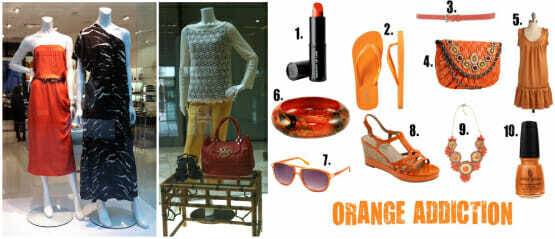
    When you think of colors that exude energy, what comes to mind?  Tangerine, of course! It’s an enticing juicy orange, vivacious and appealing.  Tangerine radiates warmth, cheer and excitement!  It’s really a fun color!!

    On a recent trip to the Big City (aka San Francisco), I found tangerine hues everywhere from dresses to handbags, nail polish, shoes, headbands, earrings.  This sunny, citrus punch of color was everywhere, so I took a few shots to share with all of you.

    Afraid to jump out of your comfort zone and purchase an orange dress or pants… then why not try some fun accessories?  Try a pair of ballet flats, a thin belt, hat, clutch, gloves, nail polish or lipstick.  A pop of orange added to any outfit of lavender, lime green or light blue is a lovely smidge of excitement!  If these items are too far-fetched, try accessorizing a nice, crisp white shirt and jeans with some fun, orange bracelets and/or a belt.  I know you can do that!

    Some of you might be thinking, “Really, Celeste?  Fashion on the Farm?”  Well, we don’t stay on the farm all of the time.  You must venture out once in awhile, am I right?

    I believe fashion is an extension of who you are.

    Fashion showcases your personality!  Some of us are over-the-top while others are a bit more conservative, but I’m thinking we all need a break from our Carhartts and need an opportunity to show a bit of personality.  If you just can’t break away from your bibs entirely, add a headband or maybe polish those nail tips – in Tangerine, of course!

    Follow me each Friday as we showcase “Fun, Fashion and Finds for Farm Girls” at www.thecouturecowgirl.blogspot.com where we talk fashion trends and fabulous finds. Why? ‘Cause we can’t talk cows all the time!!

    Celeste is a 4th generation cattle rancher on her family ranch in the foothills of the Salinas Valley on the Central Coast of California. As a young adult, she had an extensive career showing livestock. Celeste earned a B.A. in Agribusiness Marketing at California Polytechnic State University in San Luis Obispo. She works as a produce broker for Fresh Network, maintains her duties on the family cattle ranch and speaks at agricultural events nationwide.

    FOR BOOKING INFORMATION CONTACT:
    Celeste Settrini
    831-320-1527 • CSettrini@freshnetwork.com
    Follow her on Facebook & Twitter (@couturecowgirl7)
    Blog (thecouturecowgirl.blogspot.com)

    Team Latham

    January 26, 2012
    Agriculture, General, Industry News
  • Latham Hi‑Tech Seeds

    Newcomers Find Paradise in Rural America

    John and Shannon Latham started Latham Hi‑Tech Hybrids in 2004

    “You don’t know what you’ve got ‘til it’s gone” is more than lyrics to a popular song that has topped the charts since 1970. It’s also become the mantra of many young professionals, who are leaving urban areas for an increased quality of life in rural communities.

    A rural renaissance has been happening since the 1970s, says Ben Winchester, a research fellow for the University of Minnesota Extension, Center for Community Vitality. One of his current projects involves documenting newcomers, or new rural residents who range in age from 30-45 years old and are either returning to their rural roots or moving to rural areas for the first time.

    Many newcomers are basing their decisions on lifestyle and quality of life, says Winchester. One of the most interesting findings of his research is that people are not basing their decisions to move to rural areas based solely on job opportunities. Many newcomers are providing a rural brain gain. They’re bring high skill sets, such as college degrees and master’s degrees, and have a career path in place with outside connections.

    In fact, many newcomers are self-employed. One in four owns a small business, and those who own businesses are heavily invested in their communities.

    “It makes me wonder what the state of our rural economy would be if these newcomers had not been coming back these past 30 years,” says Winchester in an article posted by fedgazette.

    Instead of spending so much time focusing on the brain drain of the younger residents who leave the state, Winchester is challenging rural communities to focus on attracting – and then retaining – the 30- to 45-year-olds who are migrating to rural areas.

    Like the newcomers described by Winchester, my husband and I both moved to urban areas upon college graduation and then returned to our rural roots when our children were toddlers. After living in Kansas City and then Des Moines for a decade, I personally could never find paradise surrounded by pavement. Give me my apple trees, singing birds and buzzing bees. Give me rolling acres of waving grains and a horizon filled with sunsets instead of skyscrapers. Give me Rural America!

    Team Latham

    January 25, 2012
    Agriculture, General, Industry News
  • Latham Hi‑Tech Seeds

    The battle between the GPS industry and LightSquared 4G-LTE network continues

    The battle between the GPS industry and a proposed 4G-LTE network backed by ground towers and satellites that may conflict with GPS signals continues, according to an article published recently by Agri-Pulse.

    LightSquared is dedicated to bringing fast broadband service with minimal delay in data transfer speed. To do so, it launched a satellite in November 2010 that could give all users signal regardless of cellular range.  This all sounds like an answer to a prayer, especially for rural residents, who frequently experienced dropped calls and other issues associated with a lack of towers and limited capacity.

    The conflict arises when the faster mobile 4G service essentially out-performs the satellite sending signals to GPS devices.  If the GPS signal gets interrupted and the GPS device doesn’t receive a service, it could affect data capture in the tractor.

    For example, when I shared this story with my marketing team, one of the girls had experienced this problem first-hand six years ago when she was interning with a regional cooperative in northwest Iowa.  She was given the task of mapping field boundaries on 11,000 acres within seven days.  Due to technical difficulties, it became an extremely daunting task.  Her territory was in a very rural area, and the GPS device often lost the signal.  She would have to retrace the field boundary with a four-wheeler on which the GPS device was mounted.

    While the GPS satellite system has greatly improved since that summer mapping field boundaries, this is an excellent example to help illustrate what can happen and to help explain why the GPS industry is concerned about how its customers will be impacted by the 4G satellite.  Just imagine the consequences of the GPS signal getting interrupted when fertilizer is being applied or yields are being calculated!

    On the other hand, it’s easy to understand why LightSquared executives are upset that their project is being given the red light – or at least the yellow flag – when they’re nearly ready to launch.  They’ve had permission since 2005 to build the 4G network, yet no concerns were raised until the eleventh hour.  In the meantime, they’ve invested millions of dollars and countless hours on R&D.

    No wonder the battle continues to wage.  Let’s hope they find common ground.  Figuring out how to protect the GPS signal’s viability for farmers while providing faster, more consistent mobile phone service would certainly benefit all who live in rural America!

    Team Latham

    January 24, 2012
    Agriculture, General, Industry News
Previous Page
1 … 70 71 72 73 74 … 95
Next Page

Latham Hi‑Tech Seeds

131 180th Street | Alexander, IA 50420

(641) 692-3258

SIGNUP FOR OUR NEWSLETTER
  • Contact
  • Legal
  • Seedware Login
  • Latham Gear

© 2026 Latham Hi‑Tech Seeds. All rights reserved. | Privacy Policy

Latham® Hi-Tech Seeds is a trademark of M.S. Technologies, L.L.C., 103 Avenue D, West Point, IA 52656.